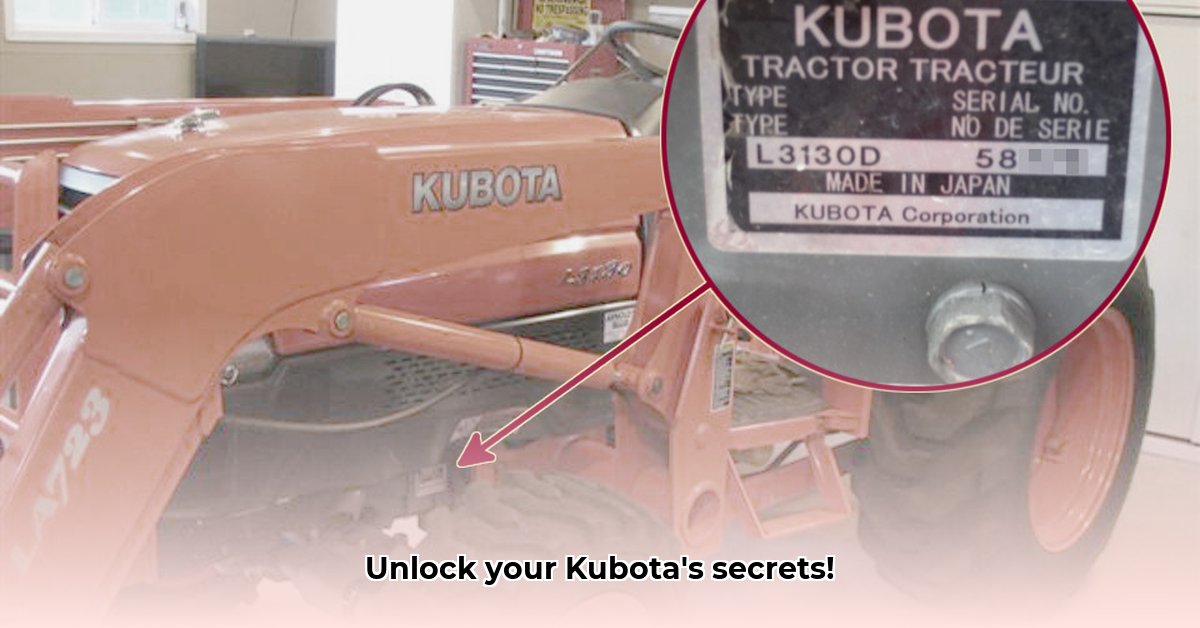
Understanding your Kubota tractor's serial number is crucial for maintenance, parts ordering, and resale value. This guide provides a step-by-step process to decode your tractor's serial number, revealing its manufacturing date and helping you understand its history. We'll cover different serial number formats across various Kubota models and offer troubleshooting tips for common issues. For other tractor brands, you might find this tractor VIN decoder helpful.
Finding Your Kubota Tractor's Serial Number
The first step is locating the serial number itself. Its location varies by model and age. Here's where to look:
Consult Your Owner's Manual: This is your primary resource. The manual should contain a diagram showing the serial number's location.
Check the Engine Block: A common location is on the engine block, often near the oil dipstick.
Examine the Data Plate: Many Kubotas have a data plate displaying various information, including the serial number. This plate might be on the chassis or under the hood.
Contact Kubota Customer Service: If you're still unable to locate the serial number, contact Kubota customer service for assistance. They may have records of your tractor's serial number.
Remember: Without the serial number, decoding is impossible. Take your time and carefully examine all potential locations.
Decoding Your Kubota Tractor Serial Number: A Guide by Era
Kubota's serial number system has evolved over time. The decoding process differs depending on the manufacturing year of your tractor.
Pre-1997 Kubota Tractors: Numeric-Only Serial Numbers
Older Kubota tractors (pre-1997) typically use shorter, all-numeric serial numbers. Precisely determining the manufacturing date from these numbers is often difficult without access to Kubota's internal databases. Contacting Kubota directly is your best approach in these cases.
Kubota Tractors (1997-May 2012): Alphanumeric Serial Numbers
This era saw Kubota adopt alphanumeric serial numbers, combining letters and numbers. While a precise decoding key isn't publicly available, here's a general approach:
First Digit: Year: The first digit typically represents the year of manufacture. However, this can vary slightly depending on the specific model.
Second Digit: Month: The second digit generally indicates the month (1 for January, 12 for December).
Remaining Digits: Unique Identifier: The remaining digits are a unique serial number for your tractor.
Example: A serial number beginning with "903..." might indicate a September 2009 manufacture date, but always verify through official Kubota resources.
Kubota Tractors (June 2012 - Present): The 7-Digit System
From June 2012 onwards, Kubota largely shifted to a 7-digit serial number system. This system is more structured and generally easier to decode.
Digits 1-2: Year: The first two digits represent the year of manufacture (e.g., "23" for 2023).
Digits 3-4: Month: The next two digits signify the month (e.g., "08" for August).
Digits 5-7: Unit Number: The final three digits denote a unique sequential unit number within that month and year's production.
Example: A serial number of "2308157" would likely indicate a tractor manufactured in August 2023.
Important Note: Always consult your owner's manual and official Kubota resources for the most accurate decoding for your specific tractor model.
Troubleshooting Serial Number Issues
Decoding your Kubota's serial number might present some challenges:
Obscured or Damaged Numbers: Clean the serial number plate carefully if it's dirty or rusty. Use a soft brush and appropriate cleaner. If severely damaged, contacting Kubota is necessary.
Incorrectly Recorded Numbers: Re-check the serial number to avoid transcription errors. Double-check each digit before proceeding.
Unusual Serial Number Format: If your serial number doesn't follow the expected patterns, contact Kubota directly for assistance.
Utilizing Your Decoded Serial Number Information
Once you've successfully decoded your Kubota's serial number, you can use this information for various purposes:
Ordering Parts: Accurate information ensures you receive the correct parts for your specific tractor model.
Scheduling Maintenance: Knowing your tractor's age helps determine appropriate maintenance schedules.
Improving Resale Value: Accurate age information enhances the credibility and value of your tractor when selling.
Complete Tractor History: Maintain detailed records of your tractor's history for future reference.
Remember, this guide provides a general overview. Always refer to your owner's manual and Kubota's official website or customer service for model-specific information and the most accurate decoding details.